Things You Must Know In Cow Dung Organic Fertilizer Making

What you need to pay attention to in the production process of cow dung organic fertilizer:
First of all, the location of the cow dung organic fertilizer plant is very critical. It is close to the raw materials. The raw materials of organic fertilizers are generally obtained locally. If the supply of raw materials is guaranteed through long-term transportation, the cost will increase a lot.

Cow dung fertilizer making process

After the cow dung enters the fermentation tank and starts to ferment, it is necessary to observe the moisture and temperature of the cow dung at any time during the fermentation, control the changes of the raw materials in time, and make timely treatment. Use the organic fertilizer fermentation turning machine to turn the heap to ensure the uniform and full fermentation of the cow dung. Fermentation bacteria can be added during fermentation to speed up the aerobic fermentation, but it is not recommended to add other biological bacteria during this period, because the temperature of the material is very high during fermentation, and many beneficial bacteria cannot withstand high temperatures. Click here to know more
After the cow dung is fermented, it is sent by the conveyor to the forklift silo for use. This silo is generally equipped with a speed regulation function, which can well control the feeding speed of the rear lingering equipment. After coming out of the silo, it enters the mixer. At this time, some auxiliary materials can be added to the raw materials. Generally, we recommend designing two mixers, one for mixing and one for discharging. After the material is stirred evenly, it need to be crushed. The organic fertilizer crusher is not the same as the general crusher. Since we need the material to maintain a certain amount of moisture, the crusher should use a semi-wet material crusher. 20%-50%, fully capable of crushing our organic fertilizer raw materials.

Granulation affects the forming effect of the entire cow dung fertilizer production line, so the choice of granulator is very important. According to the different raw materials, the models we want to use are also different. For example, we use cow dung as the raw material of organic fertilizer, and add some other organic substances (straw, sawdust, etc.) appropriately, we reommend you use organic fertilizert stirring teeth granulator, this model uses the match between the stirring teeth and the cylinder wall to force the fertilizer material into granules, and it is better for some livestock and poultry manures with relatively thick fibers.
Another thing to pay attention to is drying. We all know that organic fertilizer needs to add certain biological bacteria, but too high temperature will kill and reduce the survival of biological bacteria, so temperature control is very important.
If the output of cow dung organic fertilizer is large, we generally recommend adding drying equipment and lowering the temperature to ensure the survival of biological bacteria. It is also possible to consider adding a coating cylinder after drying to directly wrap biological bacteria on the surface of the material.

If you want to learn more about cow dung fertilizer making, please check https://fertilizerequipmentmanufacturer.com/how-to-make-organic-fertilizer-from-cow-dung/
Organic Fertilizer Composting Methods

According to different classification conditions, fertilizer compost is divided into the following 5 categories:
1. According to the oxygen demand of microorganisms, it is divided into aerobic composting and anaerobic composting. Aerobic composting is a biochemical process that relies on the action of obligate and facultative aerobic microorganisms to degrade organic matter, and its decomposition speed is fast and the cycle is short.  For this, we can provide you with professional aerobic composting machine. Anaerobic composting is a process in which organic matter is degraded by the action of obligate and facultative anaerobic microorganisms, and its decomposition rate is slow and the fermentation period is long. Most of the currently used composting is aerobic fermentation.

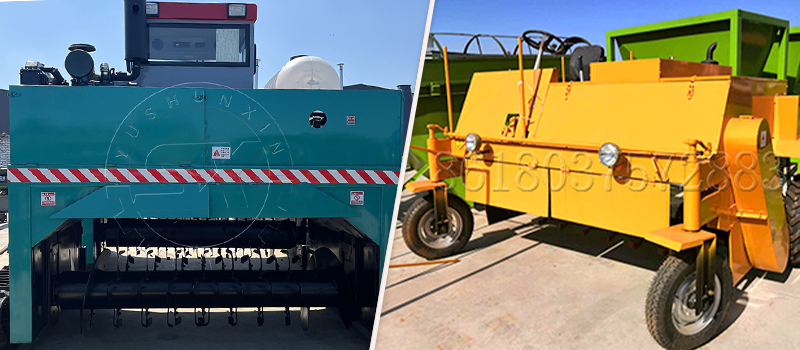
Windrow compost turner for organic waste

2. According to the temperature requirements, it is divided into medium temperature compost and high temperature compost. The fermentation temperature of medium-temperature composting is 14~45℃, which cannot achieve the purpose of harmlessness. At present, this method is rarely used. The fermentation temperature of high-temperature composting is 50-65℃, and the highest is 80-90℃. It is currently the most widely used fermentation method. In-vessel fermentation tank is a typical high remperature composter.

3. According to the form of material movement in the composting process, it is divided into static composting and dynamic composting. After the static compost pile is built, it will not be overturned until the compost is fully decomposed and transported out. Dynamic composting adopts continuous or intermittent feeding or discharging dynamic mechanical composting method, and the fermentation efficiency is high.

4. According to the composting method, it is divided into windrow-type composting and trench-type composting. windrow-type composting is that the materials are piled into strips for fermentation in an open site, and the crawler-type mechanical turning machine is used to turn the pile. The trench-type composting is to put the material into a fixed tank and close it, and turn it over with a top track-type turning machine. Click here for suitable compost machine

Equipment for organic fertilizer composting in groove

5. According to the fermentation process, it is divided into primary fermentation and secondary fermentation. A fermentation starts from the fermentation, goes through a medium temperature period, a high temperature period and then a cooling period. Secondary fermentation is that after primary fermentation, most of the easily degradable organic substances in the compost material have been degraded by microorganisms, but there are still some easily degradable and a large number of refractory organic substances, which need to be further fermented to make them change. It can form relatively stable organic matter such as humic acid and amino acid to reach maturity.

More details on https://fertilizerequipmentmanufacturer.com/large-scale-composting-equipment/