Top 5 Benefits of Using a Vertical Fermentation Pot for Organic Waste Treatment

Managing organic waste effectively is essential for sustainable agriculture and environmental protection. One advanced solution gaining popularity is the vertical fermentation pot—a compact, automated system designed for rapid composting of organic materials such as animal manure, food waste, and agricultural residues. Here are the top 5 benefits of using a vertical fermentation pot for organic waste treatment:

1. Space-Efficient Design

Unlike traditional aerobic composting methods that require large areas for windrows or piles, a in-vessel fermentation pot occupies a relatively small footprint. Its upright structure allows for high-volume processing in limited spaces, making it ideal for urban farms, livestock facilities, or composting operations with spatial constraints.

2. Rapid Composting Process

Vertical fermentation pots are designed to speed up microbial decomposition through controlled temperature, aeration, and agitation. With in-built heating systems and automatic turning mechanisms, the composting cycle can be completed within 7 to 15 days, much faster than traditional methods that take weeks or even months. Learn more.

3. Odor and Pollution Control

Thanks to their fully enclosed fermentation structure, vertical fermentation pots significantly reduce odor emissions, leachate, and environmental contamination. Many models come equipped with deodorizing filters, ventilation systems, and insulation, which help maintain a clean and safe composting environment—both for operators and the surrounding community.

4. Labor and Energy Efficiency

Modern vertical composters feature automated control panels, allowing operators to monitor and adjust temperature, moisture, and oxygen levels easily. This minimizes the need for manual labor and ensures consistent compost quality. Energy consumption is also optimized through intelligent systems that only activate heating or aeration when needed.

5. High-Quality Organic Fertilizer Output

The fermentation pot produces well-matured compost rich in nutrients and beneficial microbes, ideal for improving soil health and boosting crop yields. The output can be used directly as base fertilizer or further processed into granulated organic fertilizer for commercial sale.

In conclusion, a vertical fermentation pot is a smart investment for farms, municipalities, or waste treatment facilities seeking to turn organic waste into valuable resources efficiently. Its compact design, fast processing, automation, and environmental safety make it a standout choice in modern composting technology. If you are interested in the machine, you can go to https://fertilizerequipmentmanufacturer.com/vertical-fermentation-pot/

Area Occupied By The Organic Fertilizer Factory

In many consultations, I found that some friends are more concerned about the area occupied by the organic fertilizer production factory. The following is a brief summary of the area occupation of different annual output fertilizer making.

Organic fertilizer plant layout

Under normal circumstances, an organic fertilizer factory needs a raw material temporary storage area, a high-temperature aerobic fermentation and decomposing area, an aging area, a fertilizer making area, a finished product area, and an office building.

  1. Temporary storage area for raw materials: it is only used for temporary storage of poultry manure and straw auxiliary materials. If it does not rain frequently in the local area, it can be used in the open air.
  2. Fertilizer high-temperature fermentation and decomposing area: need to build a factory building with a height of more than 5 meters. The ceiling of the workshop can be designed with color steel + sunshine board.
  3. Aging area: This area is only used for decomposing and aging fermented materials. It does not have high requirements for the factory building, and only needs to be treated with rain protection.
  4. Fertilizer making area: This area is mainly used for fertilizer formulation and packaging, and the plant height needs to be more than 6 meters. This is the space for organic fertilzer manufacturing line location.
  5. Finished product area: This area mainly places finished fertilizers, and the height of the plant needs to be more than 6 meters. Click here for process organic fertilizer making
  6. Office building: It is mainly an area for people to work and discuss business.
Organic fertilizer factory making line

The area that the organic fertilizer plant needs to occupy.

Estimation of suitable land area for organic fertilizers with different annual yields:

500 tons of organic fertilizer plant required site area: 2,000 acres

1000 tons of organic fertilizer plant required site area: 2,600 acres

2000 tons of organic fertilizer plant required site area: 3,300 acres

5,000 tons of organic fertilizer plant required site area: 5,300 acres

10,000 tons of organic fertilizer plant required site area: 10,000 acres

20,000 tons of organic fertilizer plant required site area: 20,000 acres

30,000 tons of organic fertilizer plant required site area: 30,000 acres

The required site area for a 50,000-ton organic fertilizer plant: 50,000 acres

100,000 tons of organic fertilizer plant required site area: 100,000 acres

An independent organic fertilizer factory with a capacity of more than 100,000 tons (an organic fertilizer factory with a daily raw material consumption of about 450 tons and a daily production of 300 tons) is rare.

PS: The above plant area is only an estimate, and the actual occupied area needs to consider production line configuration, production line layout and other factors.

More details of organic fertilizer production, please click https://fertilizerequipmentmanufacturer.com/how-to-make-organic-fertilizer/

Chicken Manure Organic Fertilizer Fermentation Technology

1. Preparation before composting chicken manure

During chicken droppings composting , it is advisable to choose fresh chicken manure (old chicken manure needs to add some fresh chicken manure), prepare 2-3 cm straw (straw, wheat straw, corn stalks, sawdust, rice husk), etc., if choosing to add sawdust or rice husk, It is recommended to add a part of straw cut into 2-3 cm. The function of the straw is to adjust the carbon-nitrogen ratio, to keep the material pile loose, and to adjust the moisture.

Materials used in chicken manure fertilizer making

Control the humidity of the material between 50% and 60%, and the judgment standard is to grasp the water, but not to drip. Farmers should not worry about the carbon-to-nitrogen ratio. It is not accurate to calculate the carbon-to-nitrogen ratio by yourself. It is recommended that the amount of straw added is 20%-30% of the chicken manure. Click here to know more

2. Mixing

Fermentation bacteria is  the key to better fermentation of chicken litter. Generally, 500 grams of fermentation bacteria can ferment dry chicken manure (2 tons), then add 400-600 kg of straw, and then add a certain amount of water (maintain 50% water), That is, 500 grams of fermentation agent ferment 3-4 tons of materials. And SX fertilizer mixing equipment can help you mix them evenly.

Chicken manure composting machine for sale

3. Fermentation process

  • Composting: Pile the material into a width of 1.5-3 meters or more and a height of more than 1 meter. It should be raised in winter without covering the film (it needs to be covered when there is a lot of rain). Aerobic fermentation requires air circulation and loose materials.
  • Turning: turn over when the temperature in the pile reaches 55 degrees, usually every 3-4 days, if the temperature is too high, you can drill holes for heat dissipation. Here, SX cxan provide you with suitable equipment for chicken waste composting.
  • Successful decomposing signs: generally within 10-20 days, the temperature in the pile drops to 45 degrees, and the temperature does not rise any more. The material is loose and has no odor (may have the smell of ammonia), and some materials grow white hyphae. , indicating that the fermentation has been successful.

The key to successful fermentation of chicken crap is fermentation bacteria, material looseness and moisture control. If you need more details of chicken manure fermentation, you can check https://fertilizerequipmentmanufacturer.com/chicken-manure-composting-system/

Why Fermentation Tank Is Suitable Organic Fertilizer Compost

Fermentation tank is a manure treatment integrated organic fertilizer equipment, which can operate automatically, continuously and quickly obtain environmentally friendly organic fertilizer, and turn waste into treasure. The  manure fermentation tank uses polyurethane as the insulation layer, which is less affected by the outside world and can be used for fermentation all year round, ensuring the sustainable development of large-scale farms. The integrated organic fertilizer fermentation machine has the characteristics of humanized structure design, convenient operation, stable transmission, low noise, long life, land saving, safety and environmental protection.

Fermentation tank structure :
The fermenter of the manure treatment is a vertical closed tank structure. The whole fermentation tank structure is divided into three parts: the upper part is composed of a wind and rain shelter, a testing platform and an exhaust facility. Ancillary equipment includes automatic tipping bucket elevator, exhaust gas filtration system and other devices. There is an insulation layer filled with polyurethane foaming agent in the middle (the thickness can be customized according to different regional environments), and the outer wall is made of thickened steel plate to support the tank. The lower base part is distributed with hydraulic station, fan and large thrust hydraulic mixing shaft. The middle part is a double-layer thermal insulation tank, an equipment automatic control system, a single-side base fertilizer export device, etc.

Features of manure fertilizer fermentation pot:
The organic fertilizer fermentation tank saves the floor space and reduces the requirements for the installation of the equipment. The whole equipment structure is divided into three parts, the lower part is distributed with hydraulic station, fan and large thrust hydraulic mixing shaft. The middle part is a double-layer thermal insulation tank, an automatic control system for equipment, a single-side fertilizer exporting device, etc. The inner wall of the tank is lined with 304 stainless steel plate, which prolongs the life of the tank and reduces the residue of compost. Click here to know more about fermentation tank

Horizontal fermentation tank

Advantages of fermenter tank :
The advantages of manure fermentation tank over traditional fermentation methods are that high degree of mechanization, easy operation, automatic temperature control, automatic stirring, automatic discharge, and automatic feeding; wide adaptability, integrated rapid fermentation high temperature aerobic fermentation regardless of the north and south , regardless of spring, summer, autumn and winter, it can be fermented and produced all year round.

Fermentation tank usage method:
1. The tower structure is adopted, a batch of manure is put in every day, and a batch of organic fertilizer is produced. The horizontal fermentation tank adopts aerobic fermentation process without adding any auxiliary materials.
2. Fermentation cycle of about 7 days, aerobic fermentation at 60-70 degrees high temperature and constant temperature, continuous fermentation can be achieved by inputting a single strain, and the raw materials of manure with moisture controlled within 70% can be treated. Which is a harmfuless treatment of poultry waste.
3. The moisture content of the produced organic fertilizer is about 30%, the whole process is closed, and the waste gas is deodorized and discharged harmlessly, which reasonably solves the problem of environmental pollution caused by manure.

If you are interested in it, please check https://fertilizerequipmentmanufacturer.com/horizontal-fermentation-tank/ for details

Organic Fertilizer Composting Methods

According to different classification conditions, fertilizer compost is divided into the following 5 categories:
1. According to the oxygen demand of microorganisms, it is divided into aerobic composting and anaerobic composting. Aerobic composting is a biochemical process that relies on the action of obligate and facultative aerobic microorganisms to degrade organic matter, and its decomposition speed is fast and the cycle is short.  For this, we can provide you with professional aerobic composting machine. Anaerobic composting is a process in which organic matter is degraded by the action of obligate and facultative anaerobic microorganisms, and its decomposition rate is slow and the fermentation period is long. Most of the currently used composting is aerobic fermentation.

Windrow compost turner for organic waste

2. According to the temperature requirements, it is divided into medium temperature compost and high temperature compost. The fermentation temperature of medium-temperature composting is 14~45℃, which cannot achieve the purpose of harmlessness. At present, this method is rarely used. The fermentation temperature of high-temperature composting is 50-65℃, and the highest is 80-90℃. It is currently the most widely used fermentation method. In-vessel fermentation tank is a typical high remperature composter.

3. According to the form of material movement in the composting process, it is divided into static composting and dynamic composting. After the static compost pile is built, it will not be overturned until the compost is fully decomposed and transported out. Dynamic composting adopts continuous or intermittent feeding or discharging dynamic mechanical composting method, and the fermentation efficiency is high.

4. According to the composting method, it is divided into windrow-type composting and trench-type composting. windrow-type composting is that the materials are piled into strips for fermentation in an open site, and the crawler-type mechanical turning machine is used to turn the pile. The trench-type composting is to put the material into a fixed tank and close it, and turn it over with a top track-type turning machine. Click here for suitable compost machine

Equipment for organic fertilizer composting in groove

5. According to the fermentation process, it is divided into primary fermentation and secondary fermentation. A fermentation starts from the fermentation, goes through a medium temperature period, a high temperature period and then a cooling period. Secondary fermentation is that after primary fermentation, most of the easily degradable organic substances in the compost material have been degraded by microorganisms, but there are still some easily degradable and a large number of refractory organic substances, which need to be further fermented to make them change. It can form relatively stable organic matter such as humic acid and amino acid to reach maturity.

More details on https://fertilizerequipmentmanufacturer.com/large-scale-composting-equipment/

What equipment can be used for fertilizer compost?

In the fermentation process of organic fertilizer, it can be divided into anaerobic fermentation and aerobic fermentation.

In the anaerobic fermentation of composting, anaerobic microorganisms are mainly used to carry out a series of decomposition processes under the condition of anoxic and anoxic conditions, so as to the materials are suitable for making fertilizer, and the final product is methane with a small amount of carbon dioxide and humic organic matter. There will also be other organic acid reducing substances such as sulfuric acid and ammonia. The composting process is simple and requires no manual operation, but the reaction speed is slow, the composting cycle is long, and the removal of harmful substances is incomplete.

Aerobic fermentation refers to the process of stably converting organic matter materials into humus fertilization by artificially configuring appropriate CN ratio, moisture, oxygen (ventilation), temperature and other environments to promote mass reproduction and decomposition of microorganisms. The final product of this type of fermentation can achieve maximum removal of harmful organic matter.  For this, SX can provide you with suitable fertilizer composting line.

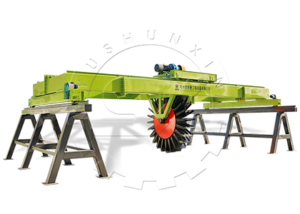
Wheel type compost turner used for large scale composting

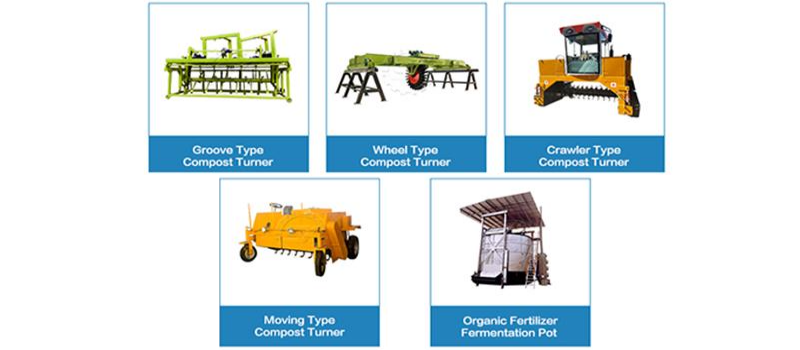
In the process of aerobic fermentation, it is necessary to build a fermentation workshop, stack the organic materials in batches in the fermentation workshop, manually adjust the CN ratio of the organic materials, adjust the moisture appropriately, and ferment after adding beneficial bacteria. , During the fermentation process, by observing the activity and reproduction of the bacteria through the change of temperature and humidity, the appropriate use of fertilizer turning machines (wheel type turning turning machines, crawler turning turning machines, trench turning turning machines) is used to process the materials. Click here to learn more details of fertilizer composter. The turning and throwing can make the bacteria fully contact with oxygen, play the role of ventilation and contact with oxygen, so that the bacteria can reproduce and decompose organic matter better. At the same time, during the stacking process, the bacteria will release a lot of heat during the decomposition process. When the heat reaches a certain temperature, the microorganisms will not be able to survive. The composting process can also fully cool the microorganisms and achieve a suitable environment for the decomposition and reproduction process.

Crawler Type Compost Making Equipment

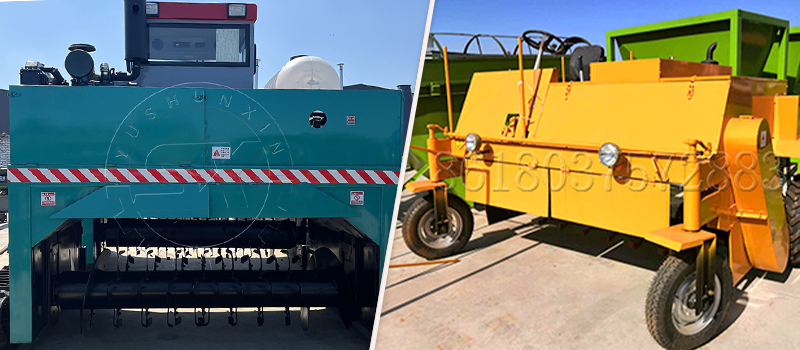
In the fermentation of organic materials, the assistance of a fertilizer turning machine can simplify the fermentation time period. Generally, organic fertilizer manufacturers use trench type fermentation in the construction of organic fertilizer fermentation workshops, and use brick-concrete structure to build the construction workshop as the organic fertilizer fermentation raw material storage place. The general construction is 4 meters or 5 meters wide. Tracks are laid on both sides of the organic fertilizer fermentation tank, and the turning rack is set on the track on the fermentation tank. The track is combined with the organic fertilizer turning machine, and the turning machine can pass the track. The organic material in the tank is fully tossed. A single wider trough can be selected with an organic fertilizer roulette turner. Ordinary or hydraulic organic fertilizer turning machines can be used for multi-channel troughs. In some places that are not suitable for building organic fertilizer fermentation tanks, organic fertilizer crawler type turning machines can be used to store organic materials in strips, and organic fertilizer crawler type turning machines can be used for successive turning.If you want to know more information, please check  https://fertilizerequipmentmanufacturer.com/compost-fertilizer-making-machine/

Trench compost turner for samll scale composting

The organic fertilizer trench turning  machine is generally composed of 16# or 22# channel steel as the main body, welding the main frame, installing the main shaft, turning teeth, motor reducer, traveling motor, hydraulic pump station, etc. The trench turning  equipment is economical and practical, and the operation is simple. It is the choice of most organic fertilizer manufacturers.