Commercial In-Vessel Composting Machine for Sale: Efficient Waste Management Solution

In-vessel composting is an advanced, controlled method of organic waste management, making it an ideal solution for businesses and municipalities seeking efficient and environmentally-friendly ways to process organic waste. The commercial in-vessel composting machine is designed to accelerate the decomposition process in a closed, contained environment, ensuring minimal odor, reduced space requirements, and faster compost production.

What is an In-Vessel Composting Machine?

An in-vessel composting facility is a sophisticated system that composts organic waste in a sealed container. This controlled environment allows for faster decomposition of materials like food waste, yard trimmings, agricultural residues, and other biodegradable materials. The machine regulates critical parameters such as temperature, humidity, and aeration, ensuring optimal composting conditions.

Features of a Commercial In-Vessel Composting Machine

1. Capacity: Commercial in-vessel composters sizes come in variousto cater to different scales of operations. For small businesses or restaurants, systems with a capacity of 1 to 5 tons per day are ideal. Larger facilities or municipalities may require machines capable of handling 10 to 100 tons per day or more.

2. Automated Control Systems: These machines come equipped with advanced control systems that monitor and regulate essential composting factors such as temperature, moisture levels, and airflow. Automation ensures consistent compost quality and reduces the need for manual intervention.

3. Energy Efficiency: Many commercial in-vessel composting machines are designed to be energy-efficient, using features such as heat recovery and optimized aeration systems to minimize energy consumption while speeding up the composting process.

4. Odor Control: One of the primary benefits of in-vessel composting is its ability to control fertilizer composting odors. The closed design of the system, coupled with advanced filtration systems, ensures that any odors are either neutralized or filtered out, making it suitable for urban areas or places with stringent odor control regulations.

5. Aeration and Mixing: Proper aeration is critical for efficient composting. Most in-vessel composters come with automated mixing or turning systems to ensure the organic materials are well-aerated, speeding up fertilizer aerobic fermentation and improving the final product quality.

Learn more.

Benefits of Commercial In-Vessel Composting Machines

1. Faster Composting: In-vessel composting speeds up the decomposition process, turning organic waste into compost in weeks instead of months. This makes it an efficient solution for high-volume waste processing.

2. Space-Saving: Unlike traditional composting methods, which require large open spaces, in-vessel composters have a compact design that can fit into a smaller footprint. This makes them suitable for urban settings or areas with limited space.

3. Environmental Impact: By diverting organic waste from landfills, in-vessel composting reduces greenhouse gas emissions and provides a valuable end product: nutrient-rich compost that can be used for landscaping, farming, and soil restoration.

4. Quality Control: The enclosed system allows for better control of the composting environment, leading to higher-quality compost with fewer contaminants and pathogens.

Price Range for Commercial In-Vessel Composting Machines

The price of a in-vessel composting equipment depends on the system’s capacity, features, and automation level. Small-scale machines can range from $15,000 to $50,000, while larger, more advanced systems can cost between $100,000 to $500,000 or more. Factors such as installation, maintenance, and additional accessories like odor control units or custom aeration systems may also affect the final price. Here, you can visit https://www.fertilizerbusinessplan.com/in-vessel-composter/ for precise quote.

Conclusion

For businesses and municipalities looking to manage organic waste efficiently, a commercial in-vessel composting machine offers a fast, space-saving, and environmentally-friendly solution. Whether you’re processing food scraps, agricultural waste, or yard debris, these machines provide a sustainable way to recycle waste into valuable compost. With a range of options available, from smaller units for local businesses to large-scale machines for municipalities, in-vessel composting is a viable investment for waste management and sustainability goals.
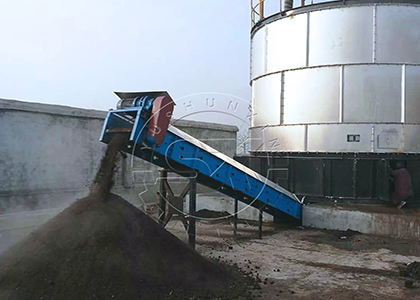
Fermentation Tank For Cow Dung Bio Fertilizer Composting

Cow dung is a common farmyard manure raw material. The output of cow dung is very large. On average, a cow produces about 20 kilograms of manure a day, and a farm with 50 cows produces about one ton of manure a day. A large amount of cow dung accumulation will seriously pollute the surrounding environment. Fermenting cow manure compost and making cow dung into bio-fertilizer is a good way to solve this problem. But the traditional cow dung composting method is slow and the deodorizing effect is not obvious. It only takes about seven days to compost cow dung bio-fertilizer with fertilizer fermentation tank.

Production process of cow dung compost

When you astart cow dung bio-fertilizer production for the first time, the fermentation bacteria must be added at the same time as the raw materials are added.

After fermentation, there is no need to add fermentation bacteria when feeding again, and the microorganisms produced in the tank can continue to ferment.

The cow dung fermenter equipment uses the decomposition of aerobic microorganisms in nature to compost cow dung. The activity of aerobic microorganisms undergoes continuous aerobic fermentation in a closed fermenter to decompose organic matter. The high temperature generated by itself will decompose the material, kill pathogens and other harmful substances, reduce the moisture content of the material, reduce the volume, and eventually produce a bio-organic fertilizer rich in a large amount of organic matter. Aerobic fermentation is a treatment method for obtaining organic fertilizer with less odor and energy saving.

Cow dung compost made by fermentation tank

Cow dung fermentation organic fertilizer fermentation tank process:

The processing of cow dung with organic fermentation tank generally includes four processes of feeding, high-temperature fermentation, decomposing, discharging, and stacking and stabilizing treatment.

  • Material loading: Put the material into the hopper with a bucket truck, and automatically load the material into the fermentation tank with one key.
  • High-temperature fermentation and decomposing: the vertical fermentation tank has a vortex air pump to send oxygen through the aeration holes on the stirring shaft, and at the same time the stirring shaft is stirring, and the temperature is gradually raised to 50-65 degrees under the action of aerobic bacteria agent. After more than 7 days of high-temperature fermentation Ripe. Effectively kill insect eggs, pathogenic bacteria and weed seeds, and achieve harmless and reduction treatment standards.
  • Material discharge: The material in the fermentation chamber falls layer by layer under the stirring of the main shaft and the action of gravity. After the fermentation is completed, the finished material is discharged from the discharge port

After the livestock and poultry manure is fermented by the bio-organic fertilizer and the fermenter, the fertilizer effect is better, the use is more convenient, and the utilization rate of chemical fertilizers can also be improved. The two can not only ferment cow dung, but also various poultry manure such as chicken manure, sheep manure, pig manure can be fermented into bio-organic fertilizer, and the fermentation method is basically the same. Click here to learn more about fermentation tank

Afterwards, as long as the normal feeding and production keep the fermentation process going, comprehensive stirring, ventilation, heat insulation and other measures are realized through the operation of the fermenter, and an excellent environment suitable for microbial reproduction can be created, the reproduction speed of microorganisms can be greatly accelerated, and the “biological fermentation” can be promoted. -The process of “harmless treatment of livestock and poultry manure and carcasses” realizes large-scale and factory-like treatment. If you are interasted in cow dung compost making, you can visit https://fertilizerequipmentmanufacturer.com/how-to-make-compost-with-cow-dung/ for more details.

Why Fermentation Tank Is Suitable Organic Fertilizer Compost

Fermentation tank is a manure treatment integrated organic fertilizer equipment, which can operate automatically, continuously and quickly obtain environmentally friendly organic fertilizer, and turn waste into treasure. The  manure fermentation tank uses polyurethane as the insulation layer, which is less affected by the outside world and can be used for fermentation all year round, ensuring the sustainable development of large-scale farms. The integrated organic fertilizer fermentation machine has the characteristics of humanized structure design, convenient operation, stable transmission, low noise, long life, land saving, safety and environmental protection.

Fermentation tank structure :
The fermenter of the manure treatment is a vertical closed tank structure. The whole fermentation tank structure is divided into three parts: the upper part is composed of a wind and rain shelter, a testing platform and an exhaust facility. Ancillary equipment includes automatic tipping bucket elevator, exhaust gas filtration system and other devices. There is an insulation layer filled with polyurethane foaming agent in the middle (the thickness can be customized according to different regional environments), and the outer wall is made of thickened steel plate to support the tank. The lower base part is distributed with hydraulic station, fan and large thrust hydraulic mixing shaft. The middle part is a double-layer thermal insulation tank, an equipment automatic control system, a single-side base fertilizer export device, etc.

Features of manure fertilizer fermentation pot:
The organic fertilizer fermentation tank saves the floor space and reduces the requirements for the installation of the equipment. The whole equipment structure is divided into three parts, the lower part is distributed with hydraulic station, fan and large thrust hydraulic mixing shaft. The middle part is a double-layer thermal insulation tank, an automatic control system for equipment, a single-side fertilizer exporting device, etc. The inner wall of the tank is lined with 304 stainless steel plate, which prolongs the life of the tank and reduces the residue of compost. Click here to know more about fermentation tank

Horizontal fermentation tank

Advantages of fermenter tank :
The advantages of manure fermentation tank over traditional fermentation methods are that high degree of mechanization, easy operation, automatic temperature control, automatic stirring, automatic discharge, and automatic feeding; wide adaptability, integrated rapid fermentation high temperature aerobic fermentation regardless of the north and south , regardless of spring, summer, autumn and winter, it can be fermented and produced all year round.

Fermentation tank usage method:
1. The tower structure is adopted, a batch of manure is put in every day, and a batch of organic fertilizer is produced. The horizontal fermentation tank adopts aerobic fermentation process without adding any auxiliary materials.
2. Fermentation cycle of about 7 days, aerobic fermentation at 60-70 degrees high temperature and constant temperature, continuous fermentation can be achieved by inputting a single strain, and the raw materials of manure with moisture controlled within 70% can be treated. Which is a harmfuless treatment of poultry waste.
3. The moisture content of the produced organic fertilizer is about 30%, the whole process is closed, and the waste gas is deodorized and discharged harmlessly, which reasonably solves the problem of environmental pollution caused by manure.

If you are interested in it, please check https://fertilizerequipmentmanufacturer.com/horizontal-fermentation-tank/ for details