The compound fertilizer production line uses monomer basic fertilizers such as: urea, ammonium nitrate, ammonium chloride, ammonium sulfate, ammonium phosphate monoammonium phosphate, diammonium phosphate, heavy calcium, general calcium), potassium chloride (potassium sulfate), etc. as raw materials. After being crushed to a certain degree of fineness, the material is agglomerated and granulated in the rolling bed of the drum granulator (or disc granulator) through humidification and heating.
SX Equipment for Processing Compound Fertilzier
During the granulation process, it can also be rotated if possible. The drum granulator adds a small amount of phosphoric acid and ammonia to improve the granulation conditions. The granulated materials are dried, sieved, and cooled to obtain NPK compound fertilizer products. This is also one of the methods widely used in the world. The early United States, India, Japan, Thailand and other Southeast Asian countries used this method for production.
Compound fertilizer rotary pelletizer
This method has a wide range of sources of raw materials, simple processing, low investment, low production cost, quick start-up, large production flexibility, simple and easy adjustment of product grade, and strong versatility. The raw materials used are solid, and the raw materials are Reliability is not strong. Because it is the secondary processing of basic fertilizers, there is almost no environmental pollution problem. Since most of the current basic fertilizers are powdery, many small and medium-sized compound fertilizer plants mostly adopt this method.
Scientific and reasonable fermentation can promote the growth of disease-resistant organic matter in the fermentation process. With the growth of microorganisms and a series of complex biochemical reactions, microorganisms produce a large number of special metabolites, such as hormones, antibiotics, and autoimmune substances. Promote the rapid growth of crops, inhibit the spread of soil diseases, and improve the ability of crops to resist disease and stress. The organic fertilizer that is not fermented not only does not have the above advantages, because the virus and bacteria carried by itself also become the main source of crop diseases.
1. Ensure ventilation and oxygen supply at the bottom of the fermentation platform;
2. The height of the pile covered by the farmyard manure pile is 0.8-1. 5 meters, and the pile width is 1.5-2.0 meters. The appropriate length can be determined by the amount of farmyard manure. Too small compost volume is not good for heating up fermentation and thorough decomposition.
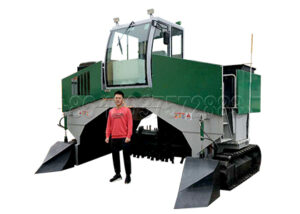
SX Wheel Type Compost Turner
3. If the farmyard manure is too long or there are too many straws, fresh manure should be added for adjustment during fermentation.
4. Cover the piled manure to prevent the farmyard manure on the air-dried surface from being completely fermented.
5. Naturally fermented farmyard manure needs to be adjusted accordingly before it can undergo secondary fermentation.
Tips for processing and fermentation of organic fertilizer raw materials.
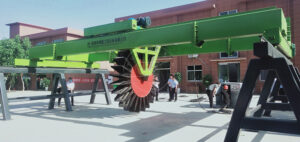
Groove Type Composter for Large Scale Composting
(1) Ferment with weeds and crop straws (it will decompose in about 12-15 days):
Use crushed or chopped weeds and crop straws (typically 3 to 5 cm in length), which can be adjusted with 40% manure or biogas residue; 2% urea (nitrogen content 46%) or equal ratio can also be used The amount of nitrogenous fertilizer is adjusted by compound fertilizer; it can also be adjusted by adding fresh livestock and poultry manure according to the weight ratio of 3:1-4:1.
(2) Fermentation with pure feces (it will decompose in about 12-15 days):
It is advisable to add crushed (chopped) weeds and crop straws for fermentation, and adjust the compost moisture to about 55%-60%. The commonly used weight ratio is 3:14:1 for adjusting fermentation.
(3) Fermentation with manure (it will decompose in about 15 days):
After expanding the volume of the bacteria directly, evenly remove one layer in the pen, stir it, and stack it directly on the fermentation platform. Repeat the operation. If the water content is too large, add an appropriate amount of crushed to the pen. The dry excipients are adjusted.
Large Organic Fertilizer Fermentation Pot
Precautions for the first use of organic fertilizer equipment are divided into the following four points.
1. The parts of the new equipment have not run-in, and there may be stuck. When the operator uses the equipment for the first time, he needs to raise the temperature of the equipment. First, raise the temperature to the motor V-belt by hand until it is comfortable. 8- 10 times, gradually heating up, about 40-50 minutes.
2. In addition to the initial temperature adjustment, the organic fertilizer equipment needs to continue to heat up after it is turned on to add heat. At the same time, it must be adjusted to different temperatures according to different properties of materials.
3. When working normally, the temperature of the machine should be kept stable, and should not rise and fall suddenly. Near the vent hole, the temperature of the machine head should be maintained at about 200 degrees. At this temperature, most materials can be processed well.
4. When shutting down, the operator should completely cut off the power supply, and remove the parts with the wrench on the machine head, and wait for the next preheating before use.
Introduction of the compound fertilizer production line
The compound fertilizer production line adopts the non-drying room temperature process production, one-time molding, the output is 1-2t/h, the compound fertilizer production line equipment investment is small, the effect is fast, and the economic benefit is good. The complete set of compound fertilizer equipment (click here to get) has a compact layout, scientific and reasonable flow, advanced technology, energy saving and consumption reduction, no three wastes, stable operation, reliable operation, convenient maintenance and wide raw material adaptability.
It is suitable for granulation of various raw materials such as compound fertilizer, medicine, chemical feed, coal, metallurgy, etc., and can produce compound fertilizer of various concentrations and various types (including organic fertilizer, inorganic fertilizer, biological fertilizer, magnetic fertilizer, etc.) .
Compound fertilizer equipment characteristics: Compound fertilizer equipment is suitable for the direct production of crude fiber organic wastes with a moisture content of about 30%, such as fermented livestock and poultry manure, sugar factory filter sludge, urban sludge, paper sludge, distiller’s grains, straw, and peat. It can produce pure organic fertilizer, organic and inorganic fertilizer, and biological organic fertilizer of spherical particles.
The compound fertilizer equipment has a high ball formation rate and biological bacteria survival rate. The new technology can make the ball formation rate reach more than 90-95%. The new technology of low temperature and large air volume drying in the compound fertilizer production line can make the microbial bacteria survival rate reach more than 90%.
The compound fertilizer equipment has a short process flow and low operating cost. The organic raw materials used in the process do not require pretreatment such as drying and crushing. The process flow is short and the operating cost is low. (If traditional granulation processes such as discs or drums are used, post-fermentation Organic raw materials with a moisture content of about 30% are dried to below 13%, crushed to above 80 mesh, and the amount of organic materials added cannot be greater than 30%).