Fermentation Tank For Cow Dung Bio Fertilizer Composting

Cow dung is a common farmyard manure raw material. The output of cow dung is very large. On average, a cow produces about 20 kilograms of manure a day, and a farm with 50 cows produces about one ton of manure a day. A large amount of cow dung accumulation will seriously pollute the surrounding environment. Fermenting cow manure compost and making cow dung into bio-fertilizer is a good way to solve this problem. But the traditional cow dung composting method is slow and the deodorizing effect is not obvious. It only takes about seven days to compost cow dung bio-fertilizer with fertilizer fermentation tank.

Production process of cow dung compost

When you astart cow dung bio-fertilizer production for the first time, the fermentation bacteria must be added at the same time as the raw materials are added.

After fermentation, there is no need to add fermentation bacteria when feeding again, and the microorganisms produced in the tank can continue to ferment.

The cow dung fermenter equipment uses the decomposition of aerobic microorganisms in nature to compost cow dung. The activity of aerobic microorganisms undergoes continuous aerobic fermentation in a closed fermenter to decompose organic matter. The high temperature generated by itself will decompose the material, kill pathogens and other harmful substances, reduce the moisture content of the material, reduce the volume, and eventually produce a bio-organic fertilizer rich in a large amount of organic matter. Aerobic fermentation is a treatment method for obtaining organic fertilizer with less odor and energy saving.
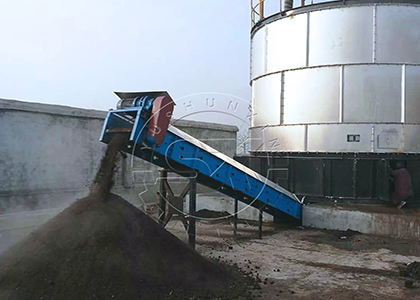
Cow dung compost made by fermentation tank

Cow dung fermentation organic fertilizer fermentation tank process:

The processing of cow dung with organic fermentation tank generally includes four processes of feeding, high-temperature fermentation, decomposing, discharging, and stacking and stabilizing treatment.

  • Material loading: Put the material into the hopper with a bucket truck, and automatically load the material into the fermentation tank with one key.
  • High-temperature fermentation and decomposing: the vertical fermentation tank has a vortex air pump to send oxygen through the aeration holes on the stirring shaft, and at the same time the stirring shaft is stirring, and the temperature is gradually raised to 50-65 degrees under the action of aerobic bacteria agent. After more than 7 days of high-temperature fermentation Ripe. Effectively kill insect eggs, pathogenic bacteria and weed seeds, and achieve harmless and reduction treatment standards.
  • Material discharge: The material in the fermentation chamber falls layer by layer under the stirring of the main shaft and the action of gravity. After the fermentation is completed, the finished material is discharged from the discharge port

After the livestock and poultry manure is fermented by the bio-organic fertilizer and the fermenter, the fertilizer effect is better, the use is more convenient, and the utilization rate of chemical fertilizers can also be improved. The two can not only ferment cow dung, but also various poultry manure such as chicken manure, sheep manure, pig manure can be fermented into bio-organic fertilizer, and the fermentation method is basically the same. Click here to learn more about fermentation tank

Afterwards, as long as the normal feeding and production keep the fermentation process going, comprehensive stirring, ventilation, heat insulation and other measures are realized through the operation of the fermenter, and an excellent environment suitable for microbial reproduction can be created, the reproduction speed of microorganisms can be greatly accelerated, and the “biological fermentation” can be promoted. -The process of “harmless treatment of livestock and poultry manure and carcasses” realizes large-scale and factory-like treatment. If you are interasted in cow dung compost making, you can visit https://fertilizerequipmentmanufacturer.com/how-to-make-compost-with-cow-dung/ for more details.

How To Use Organic Waste As Fertilizer

Organic waste is mainly organic waste discharged from agricultural production, agricultural product processing, and urban and rural residents’ lives. According to different sources, it can generally be divided into primary production waste (such as straw, grasses, branches, etc.), secondary production waste (such as poultry manure, livestock manure, etc.), agricultural and livestock product processing waste (such as bran, cake, sawdust, saccharomal, distiller’s grains, sugarcane residues, etc.).

Every year, a large amount of organic waste is produced in our country, including more than 50 billion kg of crop straw, more than 16 billion kg of forestry waste such as sawdust and wood shavings, and more than 134 billion kg of animal manure. And with the development of industrial and agricultural production and population growth The increase is also increasing at a rate of 5%-10% per year. But they are excellent materials for organic fertilizer preparing. For example:

Using animal manure and straw as fertilizer

Because livestock and poultry manure contains a large amount of organic matter and various nutrients required by crops. So using animal manure as organic fertilizer is an ideal choice to disposal of organic waste. Straw can be used to absorb sewage from livestock yards, and ammonia gas in sewage can ammonify straw to produce quality organic fertilizer. This not only solves the environmental pollution problems of livestock and poultry breeding and straw burning, but also increases organic fertilizer using, reduces the amount of chemical fertilizer, and promotes the development of ecological and organic agriculture. Click here for more about manure organic fertilizer production.

Using animal manure as fertilizer

Making sludge as organic fertilizer

Sludge fertilizer production integrates sludge reduction, harmlessness, stabilization and resource utilization. It makes full use of the characteristics that the sludge contains a large amount of nitrogen, phosphorus, potassium required for plant growth and development. So preparing  organic fertilizer from sludge is an good idea to treat large-scale treatment of sludge . After  fermenting with professional compost machine, the content of effective nutrients o sludge is increased, the odor of the sludge is eliminated, and the content of harmful substances is reduced. Studies have shown that rational application of activated sludge can improve soil, increase soil fertility and improve crop yield and quality without polluting soil and crops. These studies have laid a certain foundation for the development and utilization of my country’s huge sludge resources.

To sum up, for organic agriculture, a large amount of organic waste is a material that is discarded as a hazard and used as a treasure. Seeking effective ways to make use of organic waste, and to strengthen the resource utilization of organic waste will contribute to the conservation of nature. It is of great significance to conserve resources, prevent environmental pollution, and realize a virtuous circle of ecological economy. If you want to know more about it, you can visit https://fertilizerequipmentmanufacturer.com/organic-fertilizer-production-equipment/

How To Dispose Of Animal Manure In Farm

With the country’s further emphasis on environmental protection, livestock and poultry manure in the breeding industry is also one of the main sources of environmental pollution. But at the same time, if the livestock and poultry manure is processed, it is also a valuable organic fertilizer resource.Through processing animal manure into quality fertilizer  can not only turn waste into treasure, but also realize the reuse of resources. At the same time, it can also reduce the pollution of the environment and prevent the spread of diseases.

Using animal manure as fertilizer

Then what is the process of manure fertilizer making?

First of all, we need to ferment the collected livestock and poultry manure. There are many ways to ferment. You can choose a fermenter to ferment, build a fermenter to store in a fermenter, or the most primitive stacking for fermentation. It is necessary to add corresponding auxiliary materials (straw, bean dregs, humic acid, etc.) to ferment the fermentation tank or fermenter to increase the organic matter in the raw materials and accelerate the fermentation stage. The fermentation agent has the main functions of deodorizing, sterilizing, decomposing harmful substances in livestock and poultry manure, killing weeds, and accelerating the fermentation cycle. The original composting fermentation has a long fermentation period, which pollutes the environment more, and the harmful substances in the manure of livestock and poultry cannot be effectively removed. In the tank fermentation, it is necessary to turn over the manure of livestock and poultry, so that the microbial agent can better reproduce and decompose the harmful substances in the raw materials. Therefore, in the fermentation stage, it is necessary to use compost making machine (hydraulic turning machine, roulette turning machine, chain plate turning machine, etc.).

After the materials are fermented, turned and decomposed, they need to be transported to the secondary storage area with a forklift. Use a forklift to transport the material to the organic fertilizer forklift feeding bin, and through the uniform feeding and unloading of the forklift feeding bin, use the belt conveyor to transport the material to the organic fertilizer semi-wet material grinder for crushing. The material crushed by the pulverizer is transported to the organic fertilizer powder screening machine through the belt conveyor. The screened material can be directly packaged into powder organic fertilizer, and can also be used as the raw material of granular organic fertilizer. Click here for organic fertilizer business plan

If it is necessary to add nitrogen, phosphorus and potassium (NPK) elements to the sieved powdered organic fertilizer to make organic compound fertilizer, the powdered raw material and nitrogen, phosphorus and potassium (NPK) need to be transported to the organic fertilizer horizontal mixer in a certain proportion for stirring Mixing, conveying to the organic fertilizer granulator machine(new organic fertilizer granulator, disc organic fertilizer granulator, drum organic fertilizer granulator, stirring tooth organic fertilizer granulator, etc.) through the belt conveyor for granulation , the particles are transported to the organic fertilizer dryer by the belt conveyor for drying, and then transported to the organic fertilizer cooler by the belt conveyor for cooling after drying, and the cooled particles are transported to the organic fertilizer particle screening machine by the belt conveyor for further processing. The finished product is screened, and the unqualified products are pulled back to the pulverizer through the return belt conveyor for pulverization or directly equipped with the pulverizer for pulverization, and then continue to the granulation stage after pulverization. The finished product that passes through the organic fertilizer screening machine is transported to the organic fertilizer finished product silo by a belt conveyor, temporarily stored in the finished product silo, and then packaged by an organic fertilizer automatic packaging machine. Packed and stacked in the finished product area. If you want know more organic making systems, you can visit https://fertilizerequipmentmanufacturer.com/how-to-make-organic-fertilizer/

In the end, the harmful livestock and poultry manure becomes an organic fertilizer that is beneficial to the land and the environment. The centralized and harmless treatment of livestock and poultry manure has also produced certain economic benefits. It has avoided environmental pollution for the environment and provided high-quality organic fertilizers for the land. It really serves multiple purposes.

Common Methods For Cow Dung Treatment

With the development of cow breeding industry, cattle littter dispoal has been a difficulty for farm owners. There are two methods are commonly used by them for cow waste management.

Build a digester

In recent years, through the construction of biogas digesters to treat cow dung, it not only solves the fuel source of the masses, but also makes the cow dung fully decomposed. The residue and liquid of biogas are good organic fertilizers, which can improve the yield and quality of fruits and vegetables.

Cow dung organic fertilizer making system for sale

Converting cow crap into organic fertilizer

Dry cow dung contains 10%–20% crude protein, 1%–3% crude fat, 20%–30% nitrogen-free extract, 15%–30% crude fiber, so it has high nutrients. Organic fertilizer produced by cow dung compost  can loosen soil, improve soil compaction, chelate trace elements in the soil, and improve soil fertility. Click here for concrete process of cow dung organic fertilizer production

Using cow dung as raw material to produce organic fertilizer has characteristics of low cost, relatively stable quality and large market sales space. However, the traditional method of composting not only has a slow fermentation speed, but also cannot make the cow dung fully decomposed. After being applied to the farmland, “secondary fermentation” is prone to occur, resulting in the phenomenon of burning roots and seedlings. Here, you need a organic fertilizer composting machine. It will turn cow litter regularly to facilitate aerobic fermentation. In 15 to 20 days, it can help you finish the deodorization, fermentation, insecticide and sterilization of cow dung. The fermented organic fertilizer has good fertilizer efficiency, is safe and convenient to use, will not cause burning of roots and seedlings, and can also improve soil fertility and improve the utilization rate of cattle manure.

How to compost cow dung manure

Through the above comparison, we can clearly understand that the value of cow dung organic fertilizer is much higher than that of untreated raw cow dung. So making cow dung into organic fertilizer is an good choice for you. If you need more details, you can check https://fertilizerequipmentmanufacturer.com/cow-dung-fertilizer-machine/

Process of High Quality Bio Fertilizer Manufacturing

There are a large number of beneficial microorganisms in bio-organic fertilizers, which can decompose organic matter in the soil, increase the aggregate structure of the soil, and improve the soil composition. Microbes multiply very fast in the soil, they are like an invisible web, intricate and intricate. After the microbial cells die, many tiny pipes are left in the soil. These tiny pipes not only increase the air permeability of the soil, but also make the soil fluffy and soft, and the nutrients and water are not easily lost, which increases the soil water storage and fertilization. Ability to avoid and eliminate soil compaction. So many people start investing in bio fertilizer making plant.
The beneficial microorganisms in the bio-organic fertilizer can also inhibit the reproduction of harmful bacteria, so that we can use less pesticides. If applied for many years, it can effectively inhibit soil harmful organisms, save labor, money, and no pollution.

Bio organic fertilizer making process

However, when using the bio-organic fertilizer production line to make fertilizer, it must be thoroughly fermented and decomposed, so that the pathogenic bacteria and eggs in poultry manure such as cow dung, pig manure and chicken manure can be effectively eliminated, and the nutrients in the manure can also be decomposed into small molecular substances that can be directly absored and utilized by plant . The specific bio-organic fertilizer manufacturing technologies is as follows:
1. Adjust the initial moisture content of the bio-organic fertilizer fermentation material to about 60%. When the humidity is too high, straw, slag, cake, etc. can be added. The fermentation inoculum can be fully mixed with fine powder materials such as rice bran in advance and then scattered on the surface of the fermentation material pile. If the particle size of the auxiliary materials is too long or too large, it may wind up the turning gear of the bio fertilizer turning equipment in the later stage, causing turning over. Problems such as uneven heap or reduced work efficiency can be crushed with the help of special crushing equipment for straw.
2. During bio fertilizer fermentation, the temperature is controlled between 50~70°C and maintained for at least 7~10 days. This temperature refers to the temperature in the mid-temperature stage of bio-organic fertilizer fermentation. When the temperature of the heap continues to rise, it is necessary to use the bio-organic fertilizer turner to turn the heap, which can not only control the internal temperature, but also speed up the heap. Body water evaporates quickly. This is also an effective method to increase the internal porosity and avoid the anaerobic reaction of hypoxia to produce odor. Turn the heap every 2 to 3 days. The specific temperature of the heap is used as the standard. When the temperature begins to drop and continues to drop, stop turning the heap and let it stand for about a week to decompose before fertilizing. Click here to know more about bio fertilizer production

Equipment for bio fertilizer composting

3. After composting, in order to increase the nutrient content of the bio-organic fertilizer and improve the commerciality, a certain amount of N, P, and K can be added, and after mixing evenly with a horizontal mixer, granulation is carried out, so that the nutrients can be locked evenly and consistently. Among the particles, the phenomenon of uneven distribution is avoided. When the output is small, the dry granulator can be used for granulation, the granulation effect is good, the hardness is moderate, and the drying and cooling links can be omitted in the later stage; when the output is large, the SX rotary drum granulator can be used for granulation. granules, the ball formation rate is as high as 90%.
4. After granulation, screener and coater are used to further improve the appearance of the product. The particle size is consistent and the appearance is glossy, which attracts the attention of consumers. The higher the “face value” and “quality” of organic fertilizers, the higher the performance of the product, and the price will naturally increase. higher.
5. Packaging, the finished organic fertilizers are packaged in bags using a quantitative weighing packaging machine, and then they can be sold.

If you are interested in bio fertilizer making, you can check https://fertilizerequipmentmanufacturer.com/rotary-drum-granulator-machine/ for more details

How To Dispose of Animal Waste

Regarding the issue of livestock and poultry manure resources, General Secretary Xi Jinping said: Accelerating the disposal and recycling of livestock and poultry breeding waste is related to the production and living environment of more than 600 million rural residents, related to the rural energy revolution, and whether it can continuously improve soil fertility and manage agricultural aspects. Source pollution is a great deed that benefits the country and the people in the long run.

Cow dung for making organic fertilizer

Han Changfu pointed out that at present, five major actions have been carried out for rural environmental protection, namely, livestock and poultry manure control actions, fruit and vegetable tea organic fertilizers to replace chemical fertilizers, straw treatment actions in Northeast China, aquatic organisms protection actions focusing on the Yangtze River, and agricultural film. Recycling action.

In the livestock and poultry manure control action, Han Changfu said that our goal is: “After five years of hard work, the manure of large-scale farms across the country can be used in a harmless and resourceful manner.

We must conscientiously implement the spirit of General Secretary Xi Jinping’s important speech, and resolutely complete the hard task of resource utilization of livestock and poultry manure with more solid, powerful and effective actions, and provide strong support for the modernization of agriculture and rural areas and the construction of a beautiful China.
So how to make reasonable use of livestock and poultry manure? It is a good choice to use organic fertilizer equipment to make organic fertilizer from livestock and poultry manure. The following are the detailed steps:

First, the organic materials such as livestock and poultry manure and crop straw are fully fermented and decomposed, and then the fermented and decomposed materials are further processed and made into pellets, which are convenient for use and storage. Click here to know more

The following equipment will be used in animal manure fertilizer making:

1. Fermentation  and compost equipment: There are many types of fermentation stackers, chain plate stacker, trough stacker, mobile stacker, crawler stacker, forklift stacker, you can do it by yourself choose, you can also consult us, we will recommend the appropriate model equipment for you.

2. Pulverizing equipment: new semi-wet material pulverizer, vertical pulverizer and horizontal pulverizer, the internal structure has chain type and hammer type. Even if the material is pulled out of the water and crushed, it will not block.

3. Mixing equipment: including vertical mixer, horizontal mixer, double shaft mixer, drum mixer, etc. The internal stirring structure is divided into stirring blade type, spiral type and so on.
Design a suitable stirring structure according to the characteristics of the material. The discharge port is designed for cylinder control and baffle control.

4. Conveying equipment: belt conveyor, mobile belt conveyor, fixed belt conveyor, etc. Belt conveyor is an indispensable economical logistics conveying equipment to form a rhythmic assembly line. It has strong conveying capacity and conveying distance. It has the advantages of long distance, simple structure, easy maintenance, and convenient implementation of programmed control and automatic operation.

5. Granulation making equipment: special granulator for organic fertilizer – including disc granulator, new type of organic fertilizer granulator, rounder, drum granulator, etc. According to the characteristics of raw materials, choose the appropriate granulator.

Complete animal manure processing machines

6. Drying and cooling equipment: rotary dryer, biological organic fertilizer dryer, because the temperature of organic fertilizer cannot exceed 80°, so our dryer adopts hot air drying mode.

7. Cooler: Similar in appearance to the dryer, but different in material and performance.

8. Coating equipment: Particle coating machine – the main body is similar in appearance to the dryer and cooler, but the internal structure is very different. The inside of the coating machine is made of stainless steel plate or polypropylene lining.

9. Automatic packaging equipment: automatic metering packaging machine – including single head and double head, materials are stainless steel and carbon steel, and can customize according to the actual needs of customers.

If you are worried about animal manure disposal, you can check https://fertilizerequipmentmanufacturer.com/how-to-manage-poultry-waste/ for quality equipment.